Exploring flow-based VLA policy improvements with RL, and whether privileged critics can help those policies generalize on real hardware without a supervised fine-tuning stage between simulation and deployment.
Full Stack Roboticist
I am a second year M.S. Robotics student at the GRASP Lab, University of Pennsylvania advised by Prof. M. Ani Hsieh. Before Penn, I spent 5+ years as a Software Engineer, where I led data engineering and machine learning infrastructure serving millions of daily active users. I now bring that experience to robotics research.
My research focuses on learning-based control for manipulators, currently exploring physics-informed neural ODEs for learning unmodeled dynamics and improving predictive control of manipulators. More broadly, I'm interested in the field of robotic manipulation and love to use MPC, RL and Imitation based controls in my toolbox.
Exploring flow-based VLA policy improvements with RL, and whether privileged critics can help those policies generalize on real hardware without a supervised fine-tuning stage between simulation and deployment.
This is a research project that I am leading, with two distinct but tightly coupled parts:
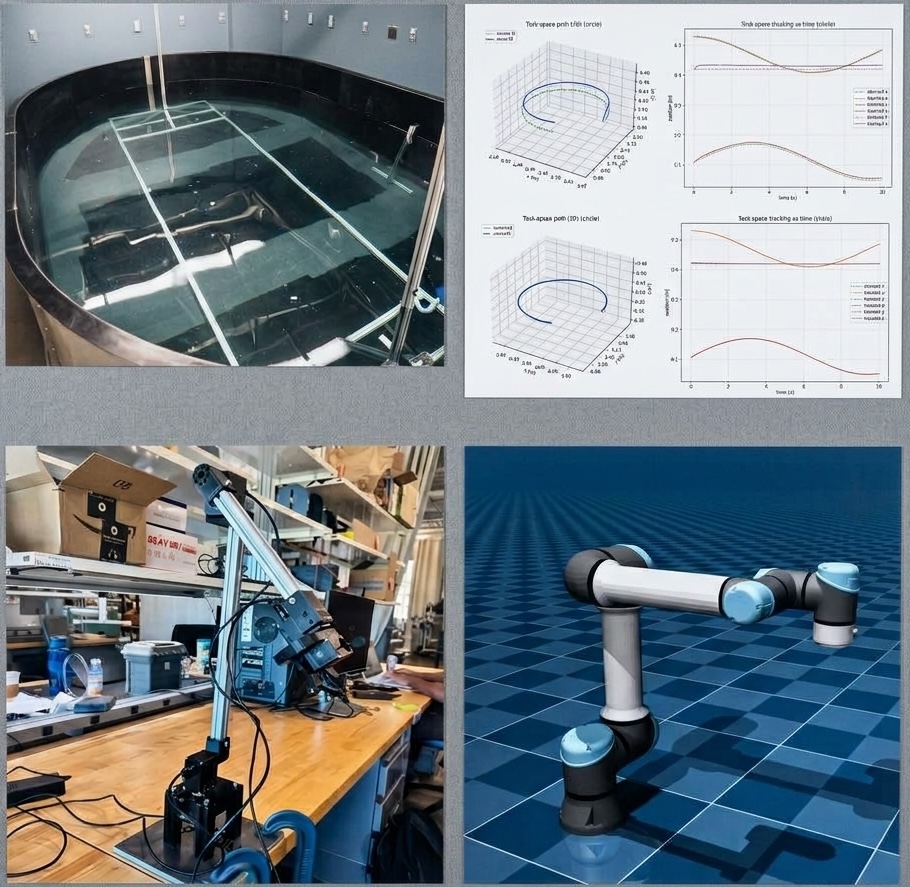
(1) Building complete software stack for a custom 4 DoF manipulator with waterproof motors, and an underwater mocap setup for data collection.
(2) Research around extending KNODE-MPC to support manipulators, using neural ODEs to learn buoyancy, hydrodynamic drag, and other unmodeled fluid forces to improve the MPC.
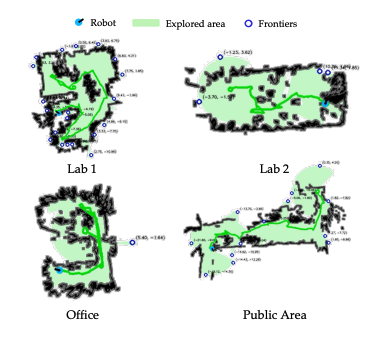
This work emerged as a byproduct of our efforts on DARPA’s Abstract Planning and Semantic Understanding challenge. For this work, I built the simulation and evaluation infrastructure for testing semantic navigation in Habitat Sim and supporting the HSSD dataset in the pipeline, enabling systematic evaluation of our approaches.
A hardware-agnostic, declarative programming model for UAVs, with native support for ML workloads across the edge-cloud continuum. We evaluated it in ROS 2, Gazebo, and PX4, and on Jetson Orin Nano and DJI Tello hardware, including real-time vision pipelines built with OpenCV, MediaPipe, and YOLO.
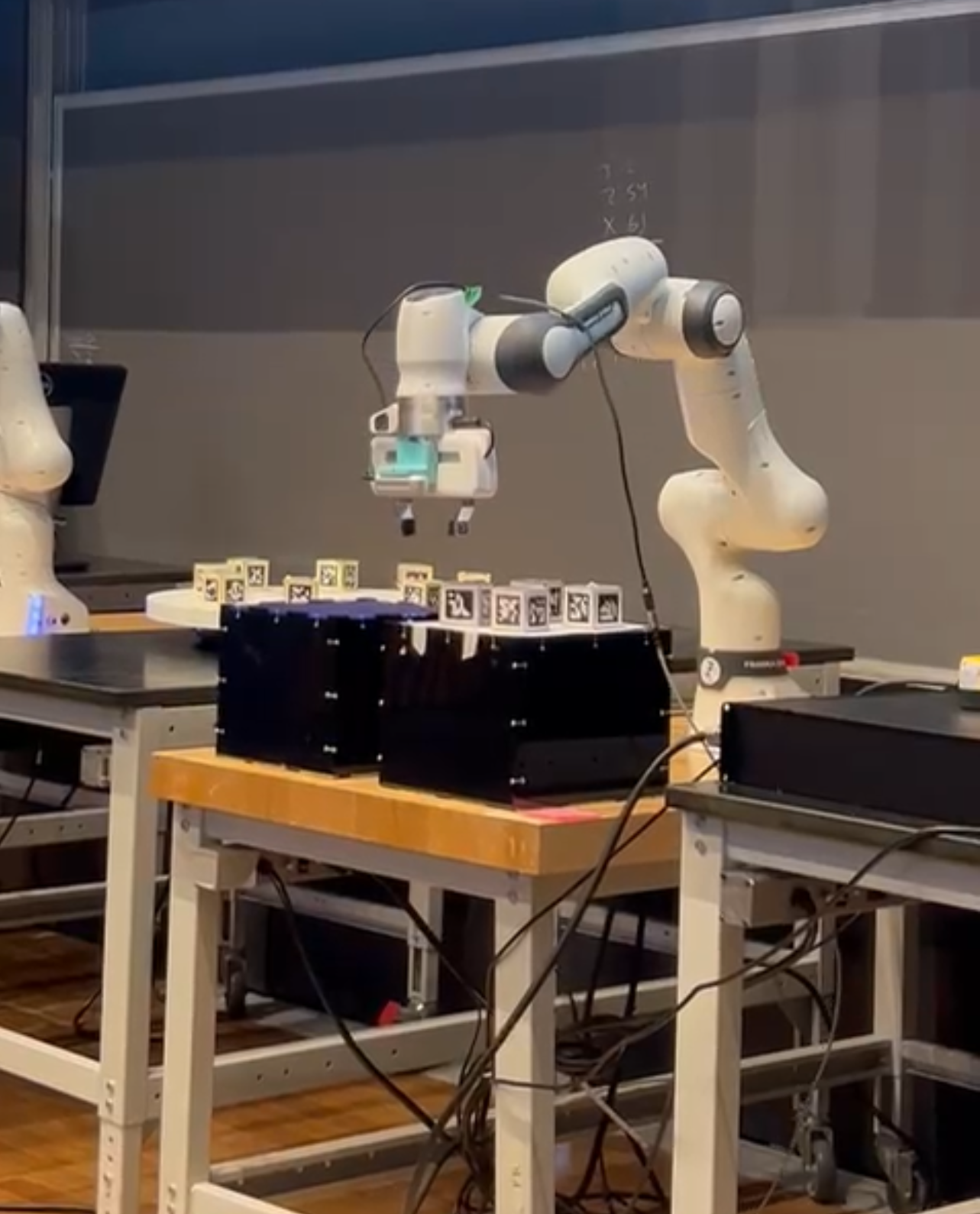
Course competition on a Franka Emika Panda arm involving vision based pick-and-place. Developed and validated the complete manipulation pipeline, from grasp planning to motion execution in Gazebo, and on real hardware, including implementing forward and inverse kinematics from scratch.
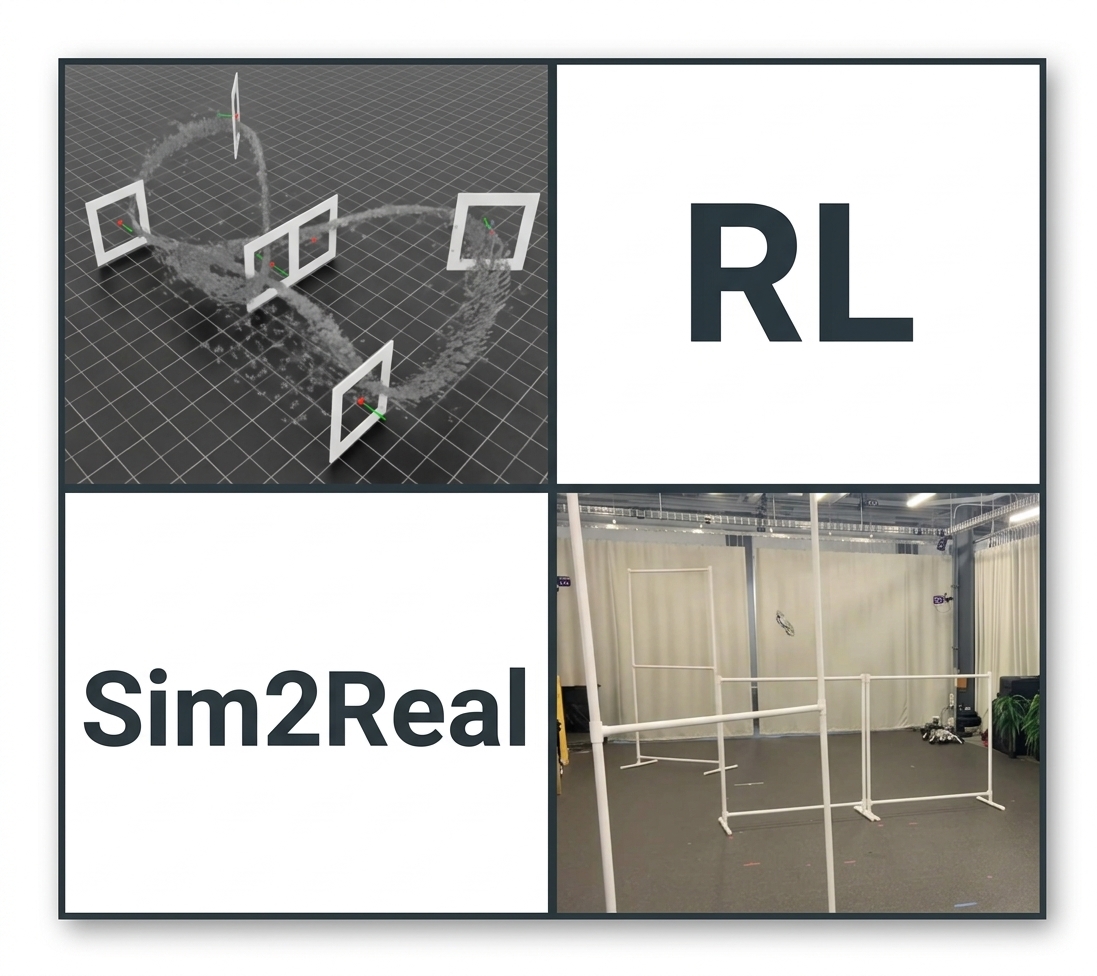
For the final competition of the course, we competed in a drone racing challenge using a Crazyflie, where the goal was to maximize real-world racing performance. Implemented PPO from scratch, experimented with reward shaping and techniques from recent RL literature, and developed a curriculum-based training strategy in Isaac Lab. Used domain randomization to transfer the learned policy from simulation to the real Crazyflie.